
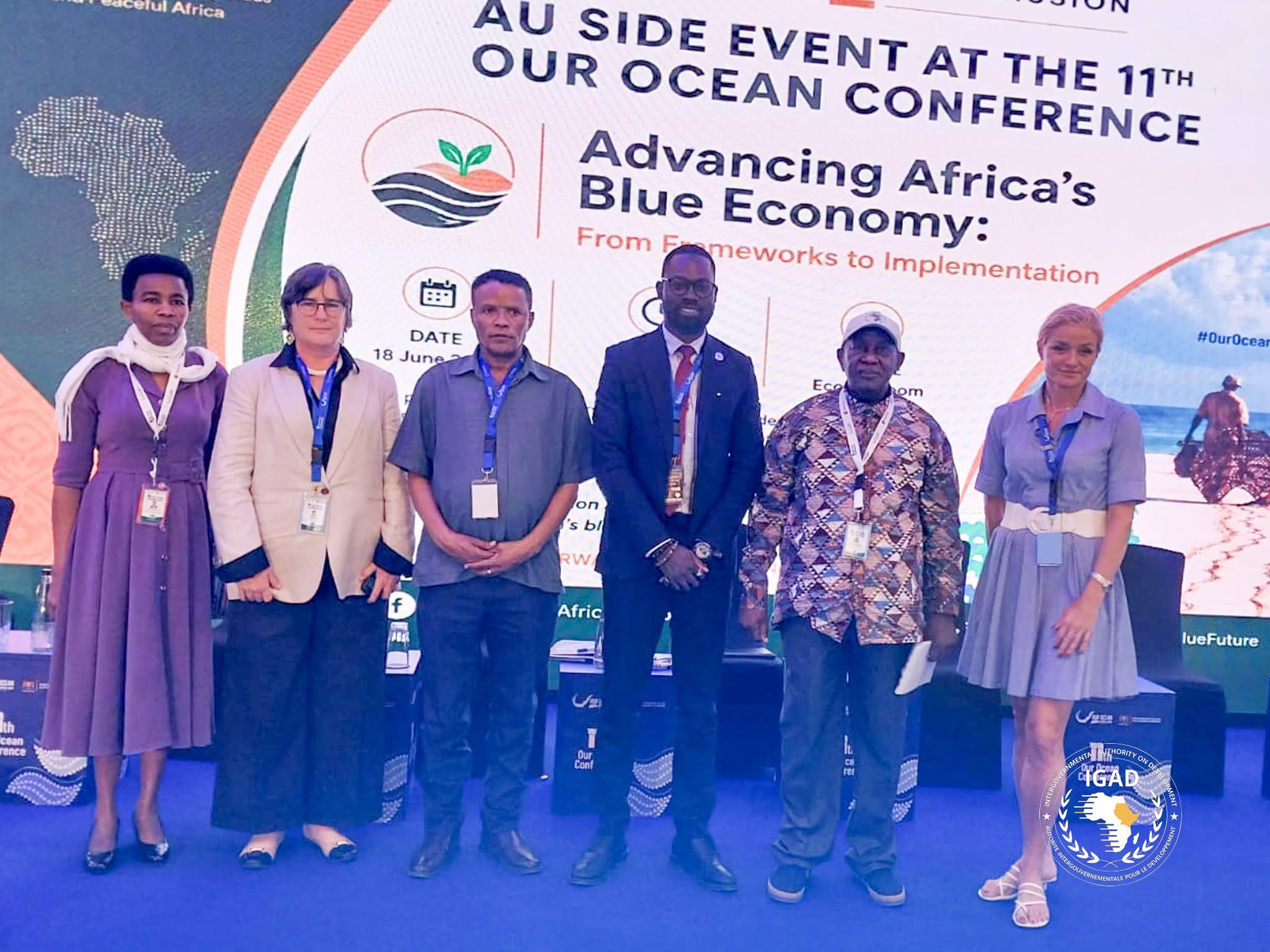
 An IGAD delegation led by Dr Eshete Dejen, Head of the Sustainable Environment Protection Unit under the Agriculture and Environment Division, is participating in the 11th Our Ocean Conference in Mombasa, Kenya.
Held in Africa for the first time, the conference brought together governments, UN Agencies, regional organisations, development partners, private sector actors, coastal communities, researchers, youth leaders, and civil society organizations to accelerate action for sustainable ocean governance, Blue Economy development, marine conservation, climate resilience, and inclusive socio-economic development.
IGAD’s participation provides an important platform to advance the region’s Blue Economy agenda from frameworks to implementation, with particular focus on sustainable fisheries, aquatic biodiversity, marine protected areas, marine spatial planning, plastic pollution prevention, coastal and inland aquatic livelihoods, and the contribution of aquatic and marine resources to food and nutrition security by promoting blue foods.
Speaking on the significance of IGAD’s participation, Dr Eshete Dejen emphasized that the conference offers a timely opportunity to position the IGAD region as a strategic player in Africa’s Blue Economy transformation.“IGAD will continue to work with Member States and partners to ensure that aquatic and marine resources are sustainably used and managed to support food security, livelihoods, biodiversity conservation, and regional economic growth,” he said.
On the sidelines of the conference, the IGAD delegation had the opportunity to engage with the delegations from Swedish Agency for Marine and Water Management (SwAM) and the Regional Environment Team from the Embassy of Sweden in Nairobi (Kenya). The discussion focused on joint collaborations on Blue Economy interventions in the IGAD region. The IGAD and SwAM as well as the Regional Environment team agreed to work together to build the institutional capacities of IGAD Member States in areas such as Marine Spatial Planning (MSP), Marine Protected Areas (*MPAs), plastic pollution prevention and gender responsive Blue Economy developments.
The IGAD delegation actively participated and promoted IGAD’s interventions in advancing Blue Economy development in the side event with the theme “Advancing Africa’s Blue Economy: from Frameworks to Implementation”, organized by Africa Union Commission (Agriculture, Rural Development, Blue Economy and Sustainable Environment (ARBE)).
This global conference, hosted by the Government of Kenya, offers IGAD and its Member States an opportunity to showcase regional progress, exchange knowledge, strengthen partnerships, and learn from global experiences in inclusive Blue Economy development and sustainable ocean management. The IGAD Secretariat has been among the Regional Economic Communities advancing structured Blue Economy cooperation on the continent. In 2022, IGAD Ministers endorsed the Regional Blue Economy Strategy and Implementation Plan, which provides a framework for strengthening governance, coordination, investment, and sustainable use of aquatic and marine resources across Member States.
With financial support from the Government of Sweden, IGAD has supported Member States to develop and endorse national Blue Economy strategies, building on the regional framework and strengthening the capacity of its Member States to translate policy commitments into concrete national actions. Through its regional coordination role, IGAD will continue to promote cooperation among Member States, support sustainable investment, strengthen policy implementation, and build partnerships that ensure the Blue Economy contributes to peace, prosperity, resilience, and regional integration.
The 11th Our Ocean Conference in Mombasa marks a significant moment for Africa’s ocean leadership and provides an important platform for the IGAD region to reaffirm its commitment to sustainable and inclusive Blue Economy development.
Source : IGAD


